Ṛtu · the seasons · one yearly cycle
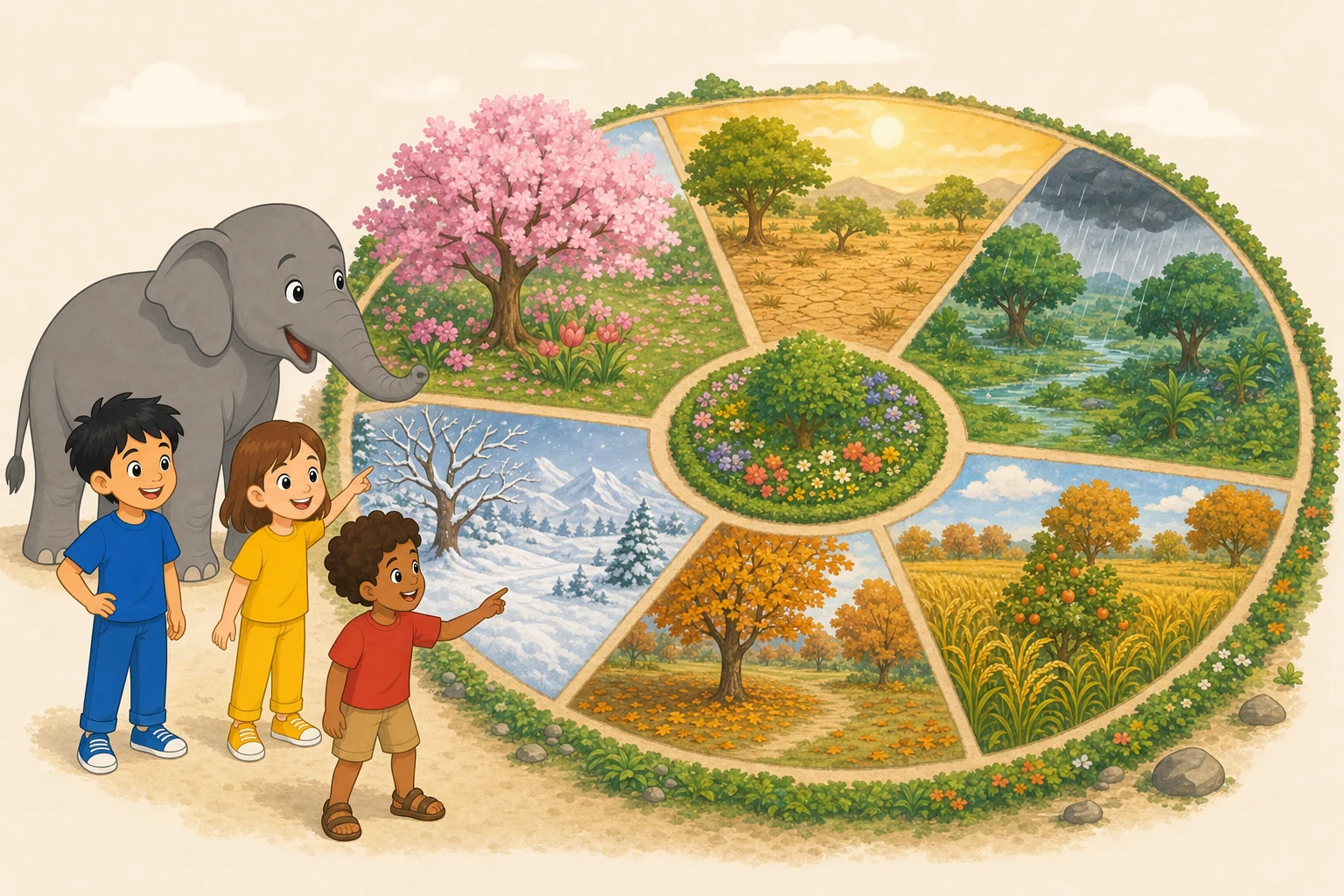
Meet the six ṛtus
Ṛtu means season. A familiar Indian sequence gives the year six seasons, including a rainy season and a pre-winter season. Another familiar model divides the same year into four seasons.
See the saṅkrāntis in actionFollow the Sun’s twelve crossings around the same annual cycle.→
One orbit · two useful maps
Watch one year become six ṛtus or four astronomical seasons.
Let the Earth travel around the Sun, pause it, or move one ṛtu at a time. Switch hemispheres to see why the four-season labels reverse north and south.
In this equal-band teaching model, three ṛtus fill the same half-year as two four-season divisions. Their boundaries therefore meet at the June and December solstices. Gold markers show the two meeting points, and Ravi will notice the pattern when Earth reaches either one.
Ravi is looking for the two places where the equal six-part and four-part maps share a boundary.
The six names
The Indian seasonal cycle gives monsoon and pre-winter their own places.
spring
hot season or summer
rainy or monsoon season
clear autumn
pre-winter
winter
These names describe a broad Indian cycle of changing heat, rain, crops, and vegetation. Calendar methods place ṛtu boundaries differently, while local weather changes gradually and differently across India.
Learning reference: NCERT, Our Wondrous World, “Our Amazing Planet”
The astronomy underneath
Earth’s tilt changes the angle and duration of sunlight through the year.
Earth’s axis is tilted about 23.5 degrees. As Earth orbits the Sun, one hemisphere leans more toward the Sun and then more away from it. That changes the height of the Sun in the sky and the length of daylight. Earth’s axial tilt drives the yearly seasons; the changing Earth–Sun distance has a much smaller role.
Astronomy reference: NASA Space Place, “What Causes the Seasons?”
Two seasonal groupings for one sky
Six and four are two ways of organizing one continuous yearly change.
The four astronomical seasons use the equinoxes and solstices as boundaries. The six-ṛtu model gives finer attention to seasonal experience in India, especially the monsoon. Neither list can describe every local climate by itself. Near the equator, in the Southern Hemisphere, or in a particular mountain, coastal, or desert region, lived seasons may follow another pattern.
The animation uses equal bands for a clear visual comparison. Regional and traditional ṛtu calendars use their own boundaries, and local weather changes gradually.