Curiosity-led discovery · connected ideas
Build the vocabulary picture
Specialized vocabulary forms a web of relationships. A new term often makes sense only after several neighboring ideas begin to fit together. Like a jigsaw puzzle, each piece adds information—and the larger picture gradually emerges from their connections.
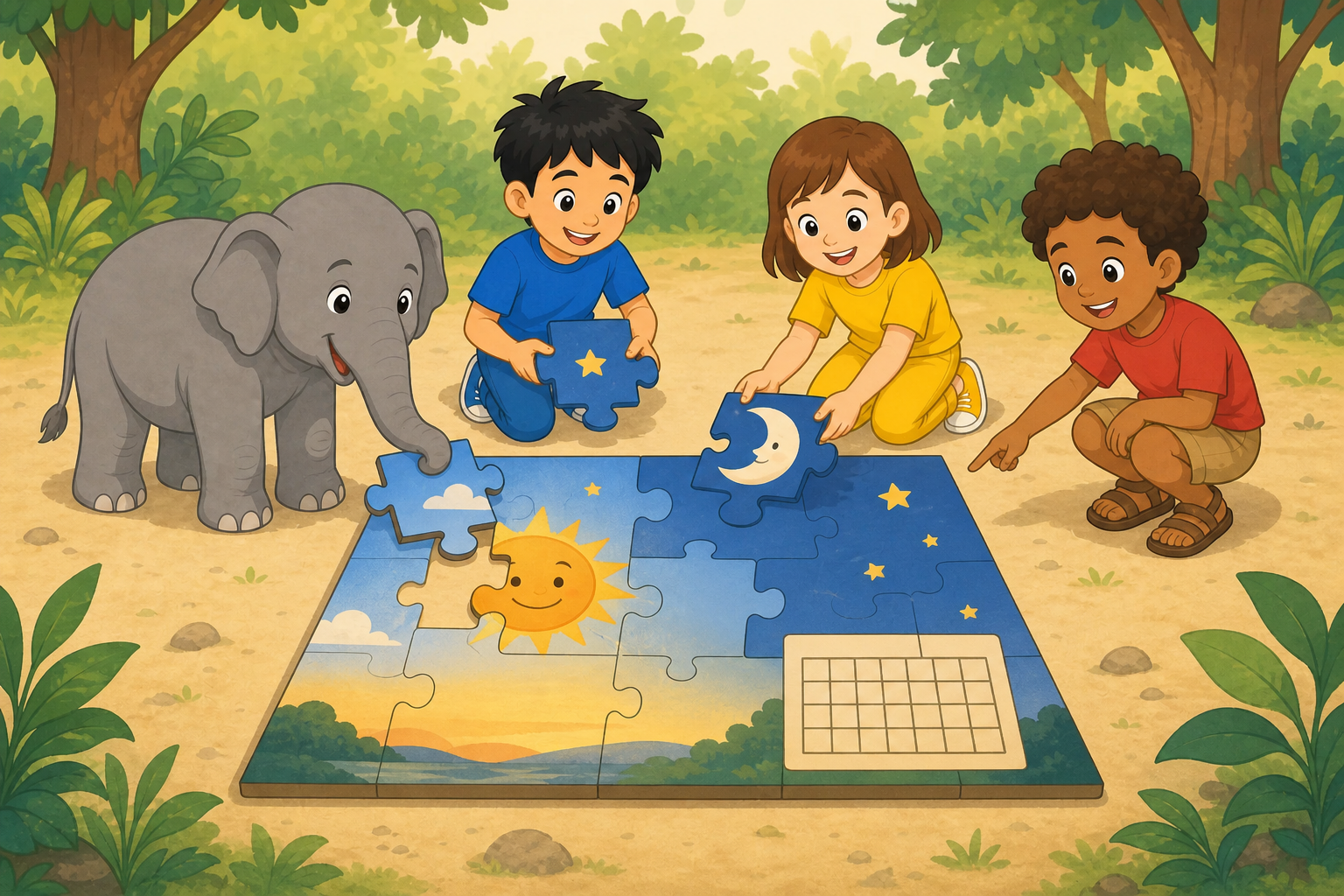
A connected vocabulary
One word opens several neighboring questions.
Consider tithi. Its short English gloss is “lunar day,” but that alone gives only part of the picture. Tithi becomes meaningful when it is connected with the changing angle between the Moon and Sun, the two pakṣas, the local sunrise, and the particular time at which an observance rule checks the calendar.
Where are the Moon and Sun, and how is their relationship changing?
A tithi names one tick in the changing Moon–Sun relationship.
Does the rule examine sunrise, moonrise, midday, early evening, or midnight?
The connected facts may connect to a specific cultural or religious observance.
Other terms form similar networks. A māsa connects New Moon boundaries with a month-naming method. An ayanāṃśa connects two ways of placing a zodiac against the sky. A vāra connects a local calendar date with the seven-day cycle.
The emerging picture
A mental model is more than a collection of definitions.
A mental model is the connected picture a learner uses to explain how something works. Knowing isolated definitions may help with recognition. Being able to connect the terms helps with reasoning: predicting what might change, explaining a result, and asking a better next question.
Ask both “What does this word mean?” and “What does this idea depend on, what other ideas does it affect, and where can I observe the connection in a real calendar result?”
Connected, manageable steps
Begin with one term and follow its connections.
Open Pañcāṅga introduces a Sanskrit calendar term when it helps answer the learner’s current question, then links it to the neighboring ideas needed to explain how it works. This just-in-time scaffolding keeps the first step manageable while making the larger system available.
A learner may begin with Gaṇeśa Caturthī, a tithi, a Moon–Sun observation, or a live calendar result. The starting point can change; understanding grows by connecting the term with the other ideas it depends on and affects.
Educational background
Curiosity-led discovery brings several learning ideas together.
Open Pañcāṅga's design draws from interest-powered connected learning, inquiry-based learning, situated vocabulary instruction, concept mapping, and just-in-time scaffolding. Several educational ideas contribute to the design. They share the view that interest can motivate a search for knowledge, words become clearer in a meaningful context, and learners need help seeing relationships as well as remembering definitions.
Educational background: Connected Learning Lab — interest-powered learning · National Academies — How People Learn II · Institute of Education Sciences — vocabulary in a science context