Pūrṇimā · Amāvāsyā · two lunar landmarks
What are Pūrṇimā and Amāvāsyā?
Pūrṇimā and Amāvāsyā are the two great boundary tithis in the Moon's monthly cycle. One culminates at the bright Full Moon; the other culminates at the New Moon, when the Moon is too close to the Sun in the sky to be seen as a nighttime Moon.
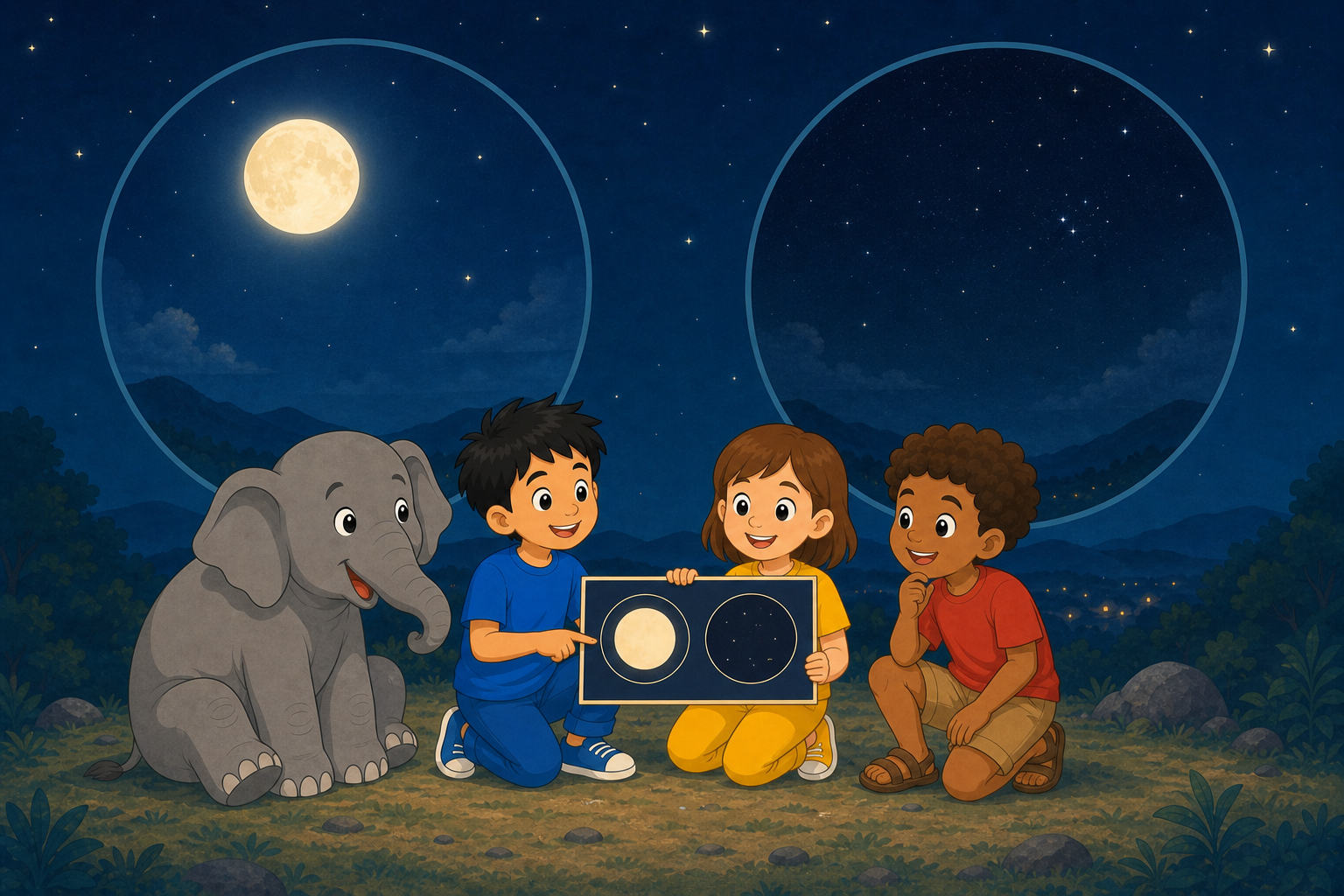
Two ends of a changing angle
The Moon and Sun tell us where each tithi begins and ends.
Śukla pakṣa is the bright, waxing half of the cycle. Kṛṣṇa pakṣa is the dark, waning half. Pūrṇimā and Amāvāsyā are therefore opposite turning points in the sequence of thirty tithis.
A tithi is an interval
Pūrṇimā and Amāvāsyā are tithi intervals.
An astronomy calendar may print one exact time for the Full Moon or New Moon. That time is a boundary instant. The corresponding tithi occupies the changing angular interval leading up to that instant.
A bright Full Moon is easy to see. At New Moon, the Moon lies in nearly the same direction as the Sun. Its unilluminated side faces Earth while it appears in the bright daytime sky near the Sun. The Amāvāsyā side of our illustration therefore shows a moonless sky.
Two questions the report answers
Which tithi is present at sunrise, and which lunar month name are we using?
A tithi lasts for an interval, not for a whole civil day. At sūryodaya, local sunrise, Open Pañcāṅga asks which tithi is underway at that moment. If it is Pūrṇimā or Amāvāsyā, the report names that tithi for the date. The Moon-phase section separately gives the exact astronomical instant of Full Moon or New Moon.
A second question concerns the month name. In an amānta calendar, the month ends at Amāvāsyā and the next month begins after New Moon. In a pūrṇimānta calendar, the month ends at Pūrṇimā. During the waning half of the cycle between that Full Moon and the following New Moon, the two systems can therefore give the same date and tithi different month names.
Open Pañcāṅga displays the amānta lunar month by default. This agrees with the new-moon-bounded lunar months described for the Government of India's Rāṣṭrīya Pañcāṅga. India's official civil National Calendar is instead the solar Śaka calendar, so it does not settle every Hindu tradition's choice of lunar month system. When an observance rule depends on a month name, its Why it appears explanation states whether the rule used amānta or pūrṇimānta. A sourced rule may use pūrṇimānta even though the report's default month display is amānta.
Some tithis pass entirely between one sunrise and the next; others are underway at two sunrises. The report explains these kṣaya and vṛddhi cases instead of forcing a tithi into a midnight-to-midnight day.
Government references: National Calendar of India (solar Śaka calendar) · IMD Rāṣṭrīya Pañcāṅga publication and downloads · IMD Annual Report 2025, p. 100 (Rāṣṭrīya Pañcāṅga lunar-month method)
One sky · many traditions
The same full-moon or new-moon tithi can be connected with many different observances.
People enjoy Full-Moon and New-Moon occasions in Hindu, Buddhist, Jain, regional, family, and temple calendars. The same tithi may be connected with different names, teachers, deities, ancestral practices, fasts, festivals, or ways of deciding the date.
Learning what the Moon is doing helps explain why a familiar observance happens when it does—and why another calendar may give it a different name or nearby date.
The report first names the shared calendar fact: Pūrṇimā or Amāvāsyā was underway at sunrise. A documented observance rule supplies any religious meaning shown with that fact. If the date is also associated with an occasion included here, such as Guru Pūrṇimā, the report shows that familiar name and explains the cultural connection.
Open calendar references: The Indian Calendar, tithi, Pūrṇimā, and Amāvāsyā · general sunrise rule