Devī across a monthly vrata and two seasonal Navarātri spans
Durgāṣṭamī and the Navarātri seasons
Durgā is a major form of Devī, the Goddess, associated with protection, strength, and the overcoming of harmful forces. Māsika Durgāṣṭamī is a monthly Aṣṭamī observance. Caitra Navarātri is a spring span and Śāradīya Navarātri is an autumn span. This guide follows nine tithi-based phases honoring forms of Devī in each season, while preserving their distinct conclusions in Rāma Navamī and Vijayadaśamī.
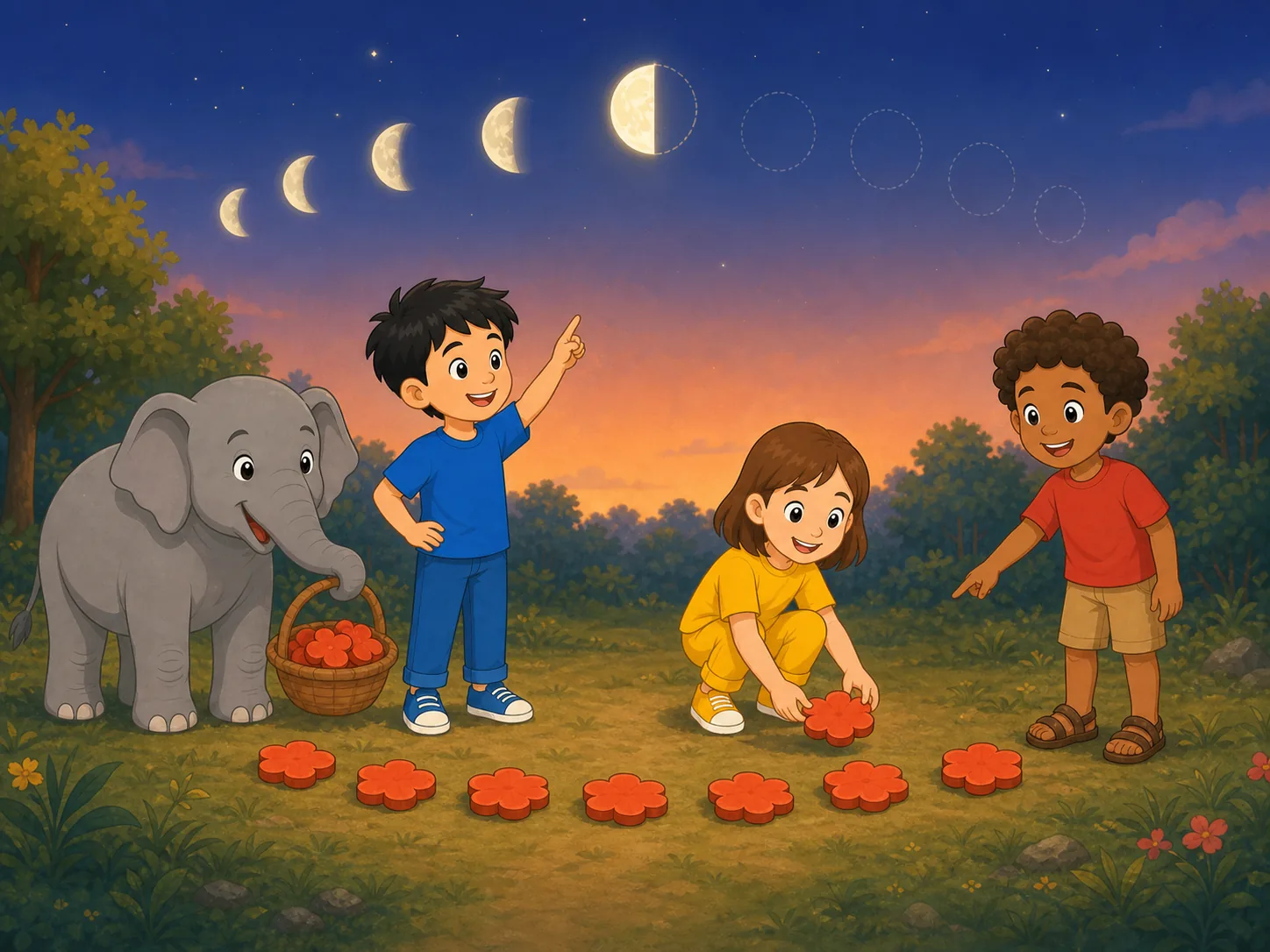
What is visible in the calculation?
Śukla Aṣṭamī is a moving Moon–Sun interval.
A tithi is each 12-degree increase in Moon–Sun elongation. Śukla Aṣṭamī is the eighth tithi of the bright, waxing fortnight, covering elongations from 84 to 96 degrees. It can begin or end at any clock time, so a calendar needs a stated convention for connecting that moving interval with a local date.
What Open Pañcāṅga checks
The monthly vrata and nine festival phases use local sunrise.
Open Pañcāṅga identifies Māsika Durgāṣṭamī when Śukla Aṣṭamī prevails at sūryodaya, the local sunrise. The result shows the sunrise time and calculated Moon–Sun elongation so you can see why the date matched. The spring span requires regular amānta Caitra, while the autumn span requires regular amānta Āśvina. Each groups Śukla Pratipadā through Navamī as nine named phases. A repeated tithi can keep one phase active at two consecutive sunrises, so the festival advances when the tithi changes rather than merely when the civil date changes.
Monthly and annual observances
The monthly vrata and seasonal Navarātri Aṣṭamī phases are distinct.
A recurring monthly vrata associated with Śukla Aṣṭamī and worship of Durgā.
The eighth phase appears in regular amānta Caitra or Āśvina when Śukla Aṣṭamī is present at sunrise; the autumn phase is commonly called Mahāṣṭamī.
When either seasonal span matches, Open Pañcāṅga shows its Aṣṭamī phase instead of repeating Māsika Durgāṣṭamī. It explains which regular lunar month and local sunrise caused the phase to appear. Some Durgā Pūjā calendars use other timing rules, including a Sandhi Pūjā interval, so they may choose a different date.
Two seasonal spans
Caitra is the spring Navarātri; Śāradīya is the autumn Navarātri.
Regular amānta Caitra, Śukla Pratipadā through Navamī at sunrise. It begins around spring and concludes with Rāma Navamī in many communities.
Regular amānta Āśvina, Śukla Pratipadā through Navamī at sunrise. Standalone Vijayadaśamī follows under its own Daśamī and aparāhṇa rule.
Open Pañcāṅga uses the same documented Navadurgā sequence to teach both spans, while their seasons, regional practices, and concluding observances remain distinct. Rāma Navamī is calculated separately at madhyāhna, so it may appear beside Caitra Navarātri phase 9 when both conditions match. A kṣaya tithi can omit a sunrise phase, while a vṛddhi tithi can keep one phase active across two sunrises.
The standalone tenth-day observance
Vijayadaśamī uses Daśamī at the disclosed aparāhṇa midpoint.
The grouped Śāradīya Navarātri result ends with Navamī. Open Pañcāṅga then evaluates Vijayadaśamī separately, requiring Śukla Daśamī during regular amānta Āśvina at aparāhṇa, the later part of daylight. This rule checks the midpoint of the fourth fifth of the local sunrise-to-sunset interval. The precise date-assignment rule remains under source review, and another pañcāṅga may select a nearby date.
Vijayadaśamī remembers Durgā’s victory over Mahiṣāsura and may conclude Durgā Pūjā.
The day remembers Rāma’s victory over Rāvaṇa, often through Rāmalīlā or public celebration.
These are prominent, documented meanings. Communities tell additional stories and observe varied rites. Regional practices may also include processions, image immersion, worship connected with tools or learning, or other forms of participation.
One documented Navadurgā sequence
The report names the active phase and the associated form of Devī.
Śailaputrī, Brahmacāriṇī, and Candraghaṇṭā.
Kūṣmāṇḍā, Skandamātā, and Kātyāyanī.
Kālarātrī, Mahāgaurī on Mahāṣṭamī, and Siddhidātrī on Mahānavamī.
This page follows one widely used Navadurgā sequence. Other communities may emphasize Durgā, Lakṣmī, and Sarasvatī; Durgā Pūjā, Garbā, Golu, Bathukammā, Āyudha Pūjā, Kanyā Pūjā, or other named practices. The report describes possibilities without assigning every practice to every user.